
 Skip to content
John Davis at NAB 2026 walks us through the new VMX Virtual Mixing Experience.


Centralize mixing across your operation. Centralize backend mixing for virtual mixers on one commercial server, PC, or Wheatstone appliance.
Scale without the buildout. Add on-air studios, production rooms, voicetrack booths, and remote mixing instances on demand — without major capital expenditure. VMX dynamically allocates mixing, routing, EQ and dynamics processing as needed.
Mix from anywhere. VMX comes with four types of virtual mixers, or tiles, that are web browser accessible. Mix from a laptop, tablet, or desktop from anywhere. Add to your studio or set up a temporary or remote studio in minutes.
A platform for every virtual mixer in your facility. Serves multiple studios in your facility, plus additional virtual mixers at the ballpark or other remote locations.
Flexible deployment. Deploy VMX on an existing Linux-based server, computer, or VMX appliance in your TOC to run multiple production rooms now, and add a dedicated Wheatstone appliance later for serving more studios.
AES67 compatible. Full interoperability within SMPTE ST 2110 facilities and other AES67 networks.
Built for redundancy. VMX can automatically failover to a second server or appliance for continuous operation when it matters most.
Easy to install. Smart setup wizard. Simply click to install the application and log in to a web browser, and you’re done in minutes.

Deploy VMX on an existing Linux server in your TOC or any of our appliances below. Number of mix instances is based on hardware.

VMX Nano is a half-rack server appliance made by Wheatstone for small scale deployment of mixing instances. Ideal for one or two virtual consoles with up to 24 faders between them (in 8 fader configurations).

VMX-R is a high capacity rack-mount server appliance made by Wheatstone for enterprise level deployment of mixing instances across one or more studio locations. Run 15 virtual consoles at once, or more, depending on number of faders and other factors.
VMX brings enterprise-level mixing power to your facility without the enterprise-level overhead. Deploy it on a commercial server or PC you already own, or choose Wheatstone’s dedicated VMX appliance for a purpose-built solution. Either way, VMX plugs directly into your existing WheatNet IP audio network and becomes the shared backbone for virtual mixers in your studio facility.
Choose from four types of mixing consoles, all accessible through any web browser via HTML5, to extend that VMX backbone throughout and beyond the studio facility. Talent can mix from a laptop or tablet at a remote location, and a temporary studio can be up and running in minutes. Easier access to mixing tools when and where they’re needed, better collaboration between talent, and more consistency in sound quality are among the day-to-day benefits of a centralized platform that dynamically allocates shared resources across the network.
VMX is AES67 compliant for full interoperability within SMPTE ST 2110 facilities and other AES67 networks, and integrates natively with WheatNet IP audio infrastructure for maximum audio quality and minimal latency. Automatic failover to a second server or appliance keeps your operation running even when the unexpected happens.
As part of Wheatstone’s Layers software-based broadcast suite, VMX works alongside audio processing, streaming, and mixing tools to fully virtualize your broadcast infrastructure. Whether you’re building a permanent facility, spinning up a temporary studio, or planning for disaster recovery, VMX scales to meet the moment.

VMX comes with four different types of virtual mixers, or tiles, from a basic mixing interface and utility mixers to full broadcast virtual consoles for television or radio applications. Tiles can be specified as needed. Instead of a fixed number of faders assigned by studio or device, you determine the number of faders needed, all available as an HTML tab on your browser. With optional WebRTC licensing, you can easily monitor audio directly through your web browser and contribute mixes back into the system.
The VMX Virtual Mixing Experience extends your facility’s mixing capability within and beyond the studio walls, giving you rapid deployment of complete mixing environments for permanent studios, pop-up productions, or emergency scenarios where getting back on air fast is everything.
VMX comes with a selection of four types of virtual mixers, or tiles, from the VML simple mixing interface and UTL utility mixers to full broadcast virtual consoles for television or radio applications. Customize tiles as needed; instead of a fixed number of faders assigned by studio or device, you determine the number of faders needed, all available as an HTML tab on your browser. With optional WebRTC licensing, you can easily monitor audio directly through your web browser and contribute mixes back into the system.

This is a virtual equivalent to our flagship LXE physical console for radio studios. Maximum 32 faders, four busses for mixes, four mix-minus busses, four aux busses for submixes, EQ and dynamics, bus-minus for every fader, and fully configurable interface with color designations and user profiles. LXE-V is a large format virtual console designed for handling call in shows, talk shows and news events requiring a sophisticated console.

Strata-V is modeled after the physical Strata console, but as a virtual equivalent, is ideal for television crews that predominantly run a production automation system but need a console interface to occasionally set levels and other controls. Strata-V is compatible with all the major video production automation systems. But don’t let its virtual aspect fool you. This is a full featured broadcast console with ample faders, subgroups, masters and 5.1 surround sound controls. Everything you can do on a physical console, you can do on Strata-V, and more. Because you can have multiple consoles running on one server, you have backup mirroring synchronized in real-time for instantaneous failover in the event of a failure.

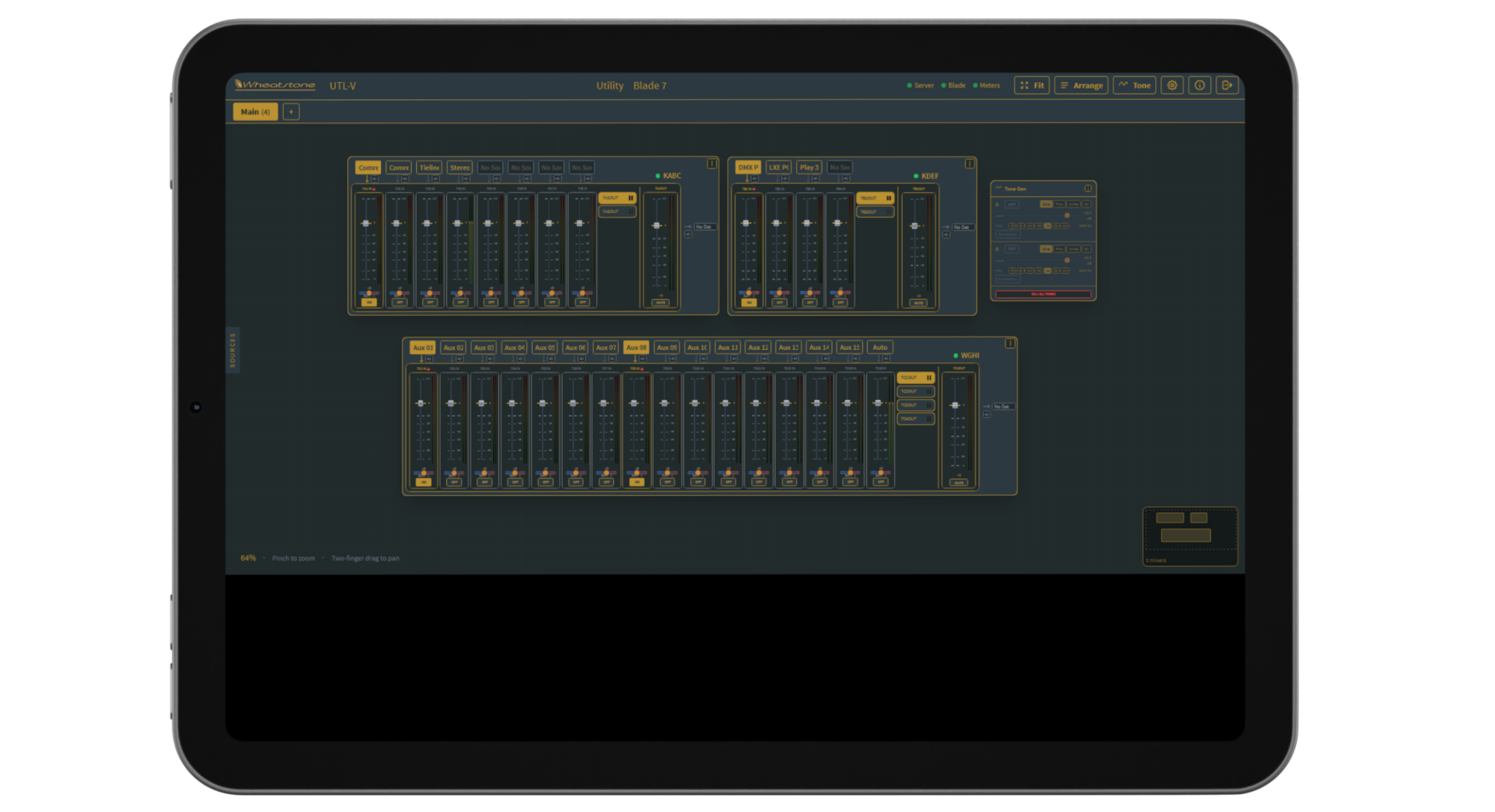
Useful for creating quick intercoms, background mixes and other basic mixing functions as needed. Spin up a UTL-V mixer with eight faders and two outputs, or four faders and two outputs. Select any UTL-V in your UTL-V “farm” of mixers and configure it in a few clicks for any number of useful purposes, from combining mics, codecs and phone sources to creating talkback or IFB feeds for a remote.

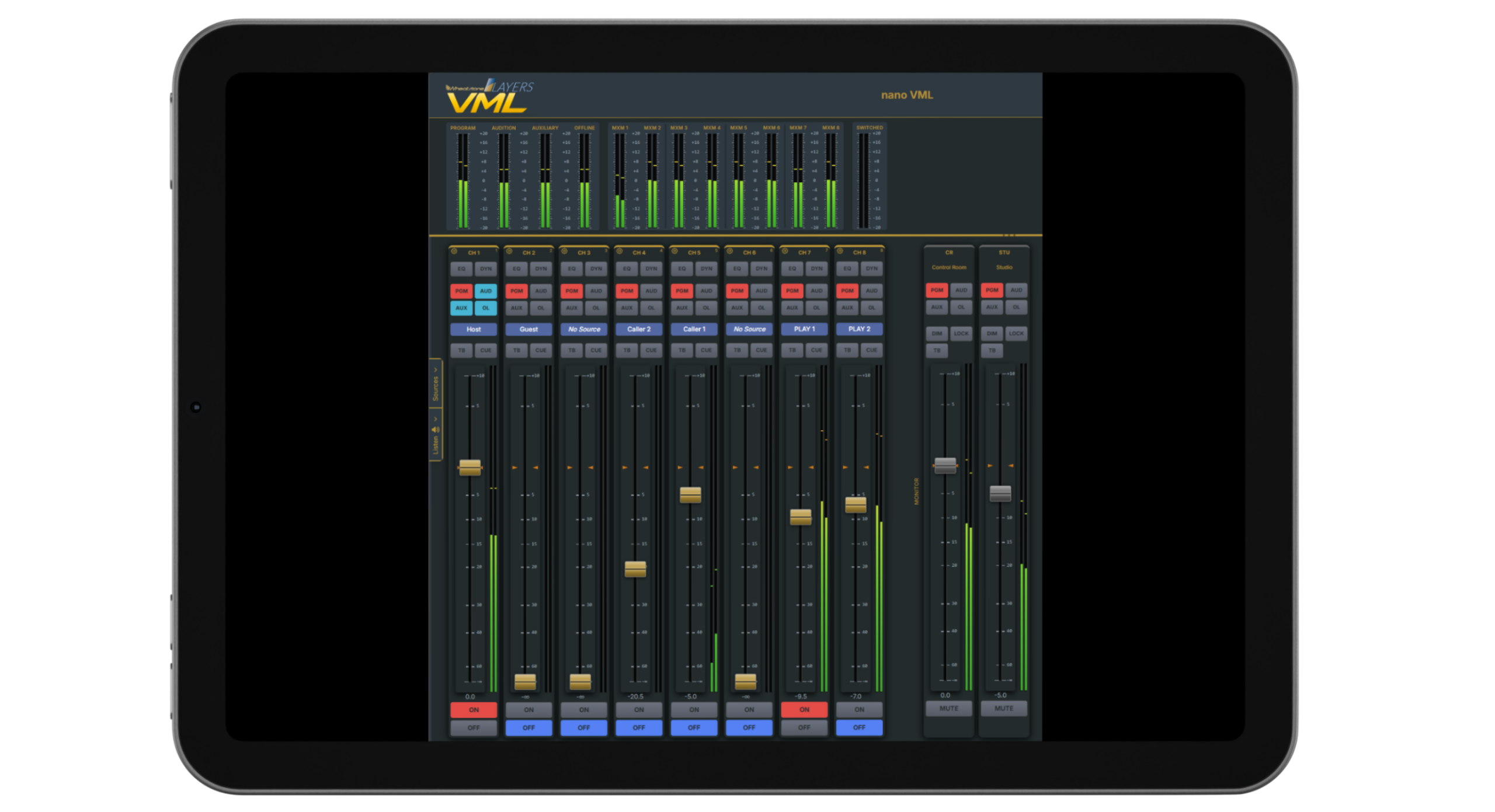
A typical VML mix instance has as few as 8 faders or as many as 24 faders with EQ, dynamics and mix-minus busses, talkback and any source on any fader. Often used with the VMX Nano half-rack server for small studios or remote applications.

If you have a Wheatstone, Audioarts, or VoxPro product, you’re an important member of the Wheatstone family and we want to hear from you, whether you have questions or need technical support, we are here for you.
Company

600 Industrial Dr.
New Bern, NC 28562 USA
Main office +1 (252) 638-7000
Fax main office +1 (252) 637-1285
We are open Monday through Friday,
8:30 AM to 8:30 PM EST


