
 Skip to content
There’s a sports term for how small decisions can add up to big wins. It’s known as the “game of inches,” a term that originated in football with this idea that moving the ball just a few inches can result in more touchdowns. A lot of what goes into broadcasting today is a game of inches, and there’s no better example of this than the multimedia transformation of ESPN Chicago.
It started small. ESPN Chicago began with social media, and that soon led to multicast video for audiences on Twitch, YouTube and other digital platforms. The immediacy of sports made ESPN Chicago the perfect candidate for distributing content across multiple platforms, and the addition of video gave them a competitive advantage in an increasingly competitive world. The dream was to stream content as video and audio on any number of platforms and to broadcast the play-by-plays on ESPN Chicago 1000 AM, the flagship for the Chicago Bears and the Chicago White Sox. That way, when a Sox or Bears game preempted the afternoon show as would tend to happen, they could broadcast games live while continuing to stream shows online, effectively giving them two revenue streams.
There was one problem. ESPN Chicago didn’t have the studios or the studio technology to pull it off professionally. The main issue was marrying video with audio during fast-moving, often live coverage or commentary. Something as simple as using a standard camera automation system for a typical sportscast was out of the question. There was nothing professional about six or so guests talking over each other during the heat of a sports discussion while the studio cameras panned back and forth one to the other like a bouncing ball. If ESPN Chicago was going to go pro with visual as an equal partner to audio, it needed a way to bring those two worlds together.
Fortunately, the game of inches was at play elsewhere in the organization. On March 1, 2022, Good Karma Brands (GKB) acquired ESPN sports radio from Walt Disney Company. That, too, happened inch by inch, first with GKB as a regional broadcaster airing ESPN radio content, then with GKB as a digital and events partner for ESPN, and soon enough with GKB taking over the daily operations of ESPN Chicago and, finally, GKB’s acquisition of ESPN owned and operated radio stations in Los Angeles, New York and Chicago. GKB went from obscurity to the big league in under 20 years, going from a small radio operator out of Beaver Dam, Wisconsin, to acquiring ESPN owned and operated stations in three of the largest radio markets in the U.S.
We’ll skip over a lot of the details here – the leases that needed wrapping up, the new studio space acquired – to get straight to the point: along with GKB’s acquisition came a new studio facility in downtown Chicago, which led to fresh engineering talent, which then led to new WheatNet IP audio networked studios, which then led to a new pro video production platform, and, finally, to what ESPN Chicago Director of Content Danny Zederman called the total multimedia transformation of ESPN Chicago.
It was truly a game of inches, with the play-by-play going something like this.
With the acquisition, GKB also brought over a few key players, like Scott Clifton, who was the senior media engineer for Disney’s ESPN and whose background included engineering for Harpo (Oprah) as well as Cumulus and SiriusXM. Scott came into the role not only as a seasoned broadcast engineer, but also with a varied background in how broadcast audio and video fit together.
That decision alone would create a chain of consequences, starting with a new WheatNet IP audio network comprising IP-16 consoles, talent stations and Wheatstream Duos for ESPN Chicago’s two control rooms and new dual-position flex studios in downtown Chicago. It was Scott’s first experience with WheatNet IP audio and he said he decided to go this route because of the “robustness and reliability” of Wheatstone products.
Installation began in early 2025, and not long after, Scott called Fritz Golman, who he had worked with on Harpo and other projects in the past and who had just started his role as Director of Media Systems with RadioDNA. At the time, Fritz was working on a WheatNet IP audio project for Houston Public Media that involved the integration of a professional production system for automating multimedia video and production at the pro level. “I called Fritz and he said, ‘Funny you should call. We have this big project we’re finishing up in Houston and it’s right up the alley of what you’re talking about,’” Scott recalled.
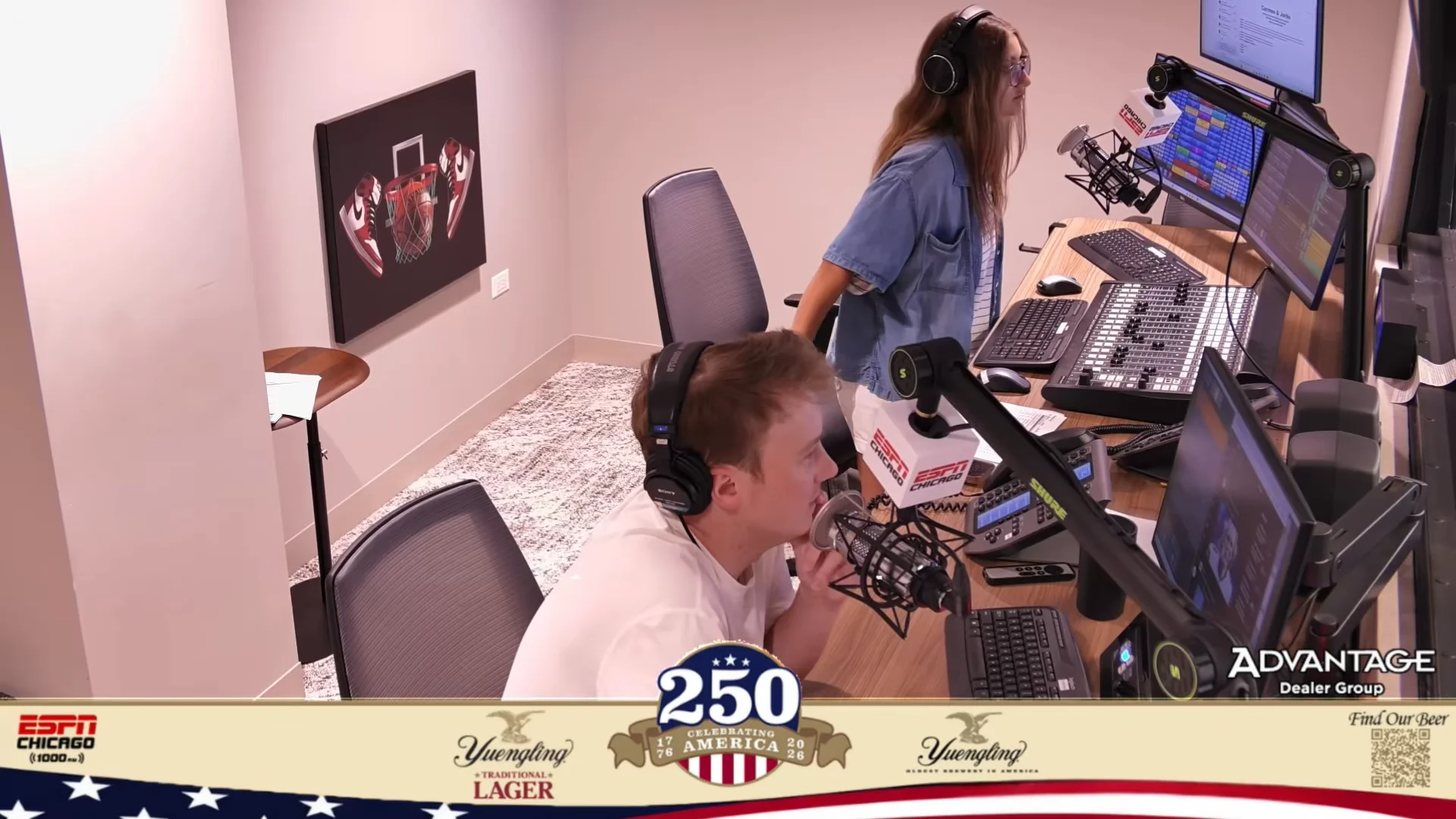
Fritz was doing something few had tried before. He was introducing to the radio environment all the pro aspects of a commercially available video production system similar to those used in TV news. The Houston project was one of the first and it centered on WheatNet IP audio, which has native IP scripting not found in most other AoIP systems, to tightly integrate video into the radio environment and therefore merge the two worlds (read Everyone Is Watching Houston Public Media for details).
“I had already made the decision to go Wheatstone, and that played well into what we wanted to do,” said Scott.
In short, what GKB wanted to do was to add all the polish of professionally-produced content without adding staff or overburdening existing radio staff with new and complicated workflows.
Fast forward months later, and ESPN Chicago is discovering a whole new world of multimedia opportunities now that Fritz has integrated the company’s new WheatNet IP audio network with its pro video production system using customized scripting. With this, ESPN Chicago is introducing a more professional aspect to its YouTube and Twitch streams, starting with that camera as a “bouncing ball” issue mentioned earlier. The new system adds “weighting” algorithms to camera automation, so instead of cameras panning back and forth between guests talking over each other, it can turn to a wide shot of the room or a split screen of two talking heads – something you see in television every day but is becoming more of a necessity for radio companies today.
“We think of GKB as a multimedia company. We are social media, we are radio, we are video. We don’t have a television product per se, but we have video and we can do so much with all of that,” commented Scott.
Company

600 Industrial Dr.
New Bern, NC 28562 USA
Main office +1 (252) 638-7000
Fax main office +1 (252) 637-1285
We are open Monday through Friday,
8:30 AM to 8:30 PM EST