 Audio researchers tell us that our auditory system can be modeled as a filter bank with 25 overlapping bandpass filters. These are known as critical bands (i.e. bins), and by modeling our Neuron FM/HD/DAB+ audio processor’s limiter on a similar band structure, we can not only surgically limit audio without affecting nearby frequencies, but also uncloak subtle audio details that wouldn’t otherwise be heard.
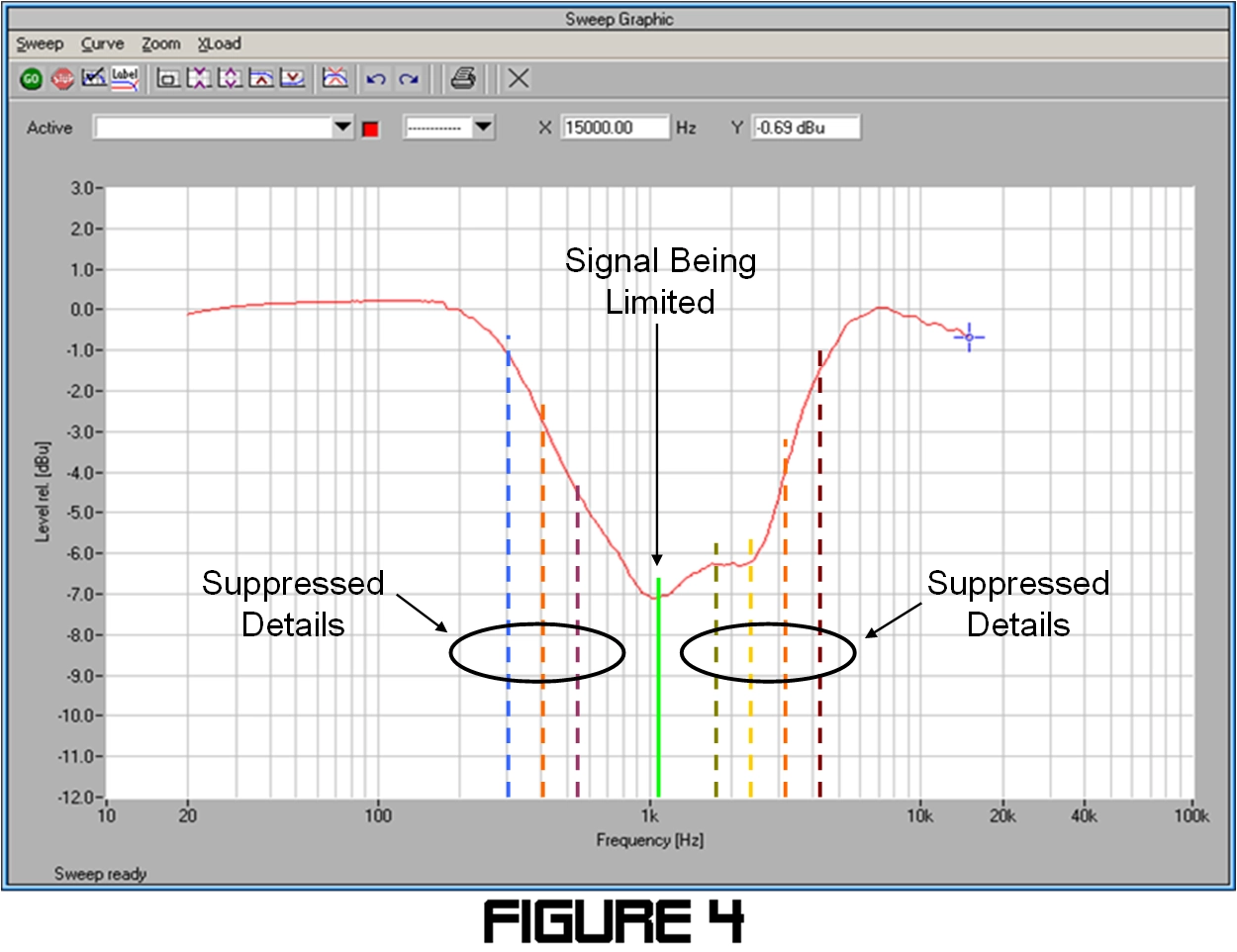
Here’s why. In a conventional multiband limiter, the broadness of each limiter band (see Figure 4) allows the act of limiting to affect a large portion of the audio spectrum; nearby frequencies that don’t even need limiting get pulled down too and many users end up driving the limiters harder and harder, trying to get those lost details back.
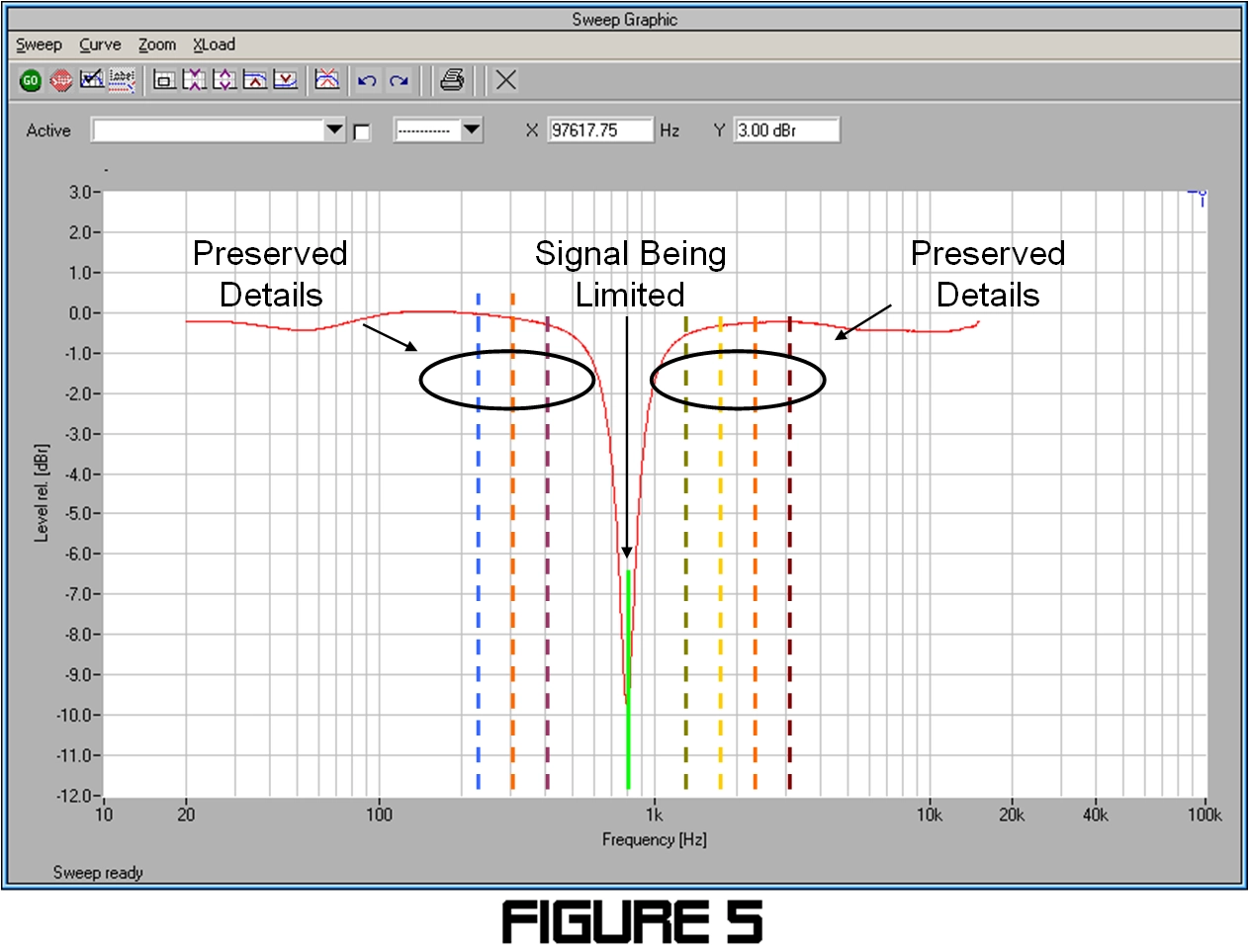 Conversely, as Figure 5 shows, each band of the spectral processor is quite narrow — note how little audio spectrum is affected by one limiter band. Even more important is how the high selectivity of the spectral processor allows adjacent audio details to be completely untouched. It is all still there. This is completely different behavior from the way multiband broadcast limiters with only a few bands work. It sounds a lot different, too!
Our patented spectral audio processor manages the energy of electrical signals without our ears noticing that limiting has even occurred.
The Science Is In The Details
When a band of the Neuron spectral audio processor reduces its gain to limit a particular frequency, two things happen. One is that the level of the signal being limited is restricted to the band’s limit threshold, just as it would be in any limiter. But what also happens is that the act of limiting a signal in one narrow band psychoacoustically raises the perceived loudness of subtle audio details residing near to, but not inside of, the band in limiting.
Even though the audio signals in the bands adjacent to the one in limiting have not undergone any modification, our brain decodes it very differently and allows us to hear subtle details in the program material not often heard from other broadcast audio processors. The mechanism for this is quite simple: The frequency in the band undergoing limiting and the audio frequencies in nearby limiter bands not being limited have undergone a change in their relative gains. Our brain doesn’t notice the effect of limiting because, psychoacoustically, it is constrained to such a narrow band. But there’s a perceived increase in the level of the nearby signals in the nonlimited bands even though their electrical amplitudes have not changed. This is entirely opposite behavior from what limiters with only a few bands do when they carve up huge chunks of the audio spectrum just to limit a single isolated signal.
The goals of audio processing haven’t changed, after all. We still need peak protection and levels normalized. But what has changed is that we can now drive so much more energy through the air chain and pass that on to listeners in a way they find energetic and vibrant.
The above is an excerpt of Jeff Keith’s article “We’re Coming Out of a ‘Deep Compression’”, which appeared in Radio World’s May 2026 ebook “Optimize Your Air Chain.”